Phone-ins
A phone-in is not a break, which is one script in one voice. A call is a short programme: your host puts a caller on, the caller answers, the host comes back, and each turn is its own model call spoken in its own voice. The turns are joined into one piece of audio and go into the running order as a single item. Everything about a call that can be arithmetic (who speaks when, how long a turn is, how many people ring in) is decided by the station, not by the model.
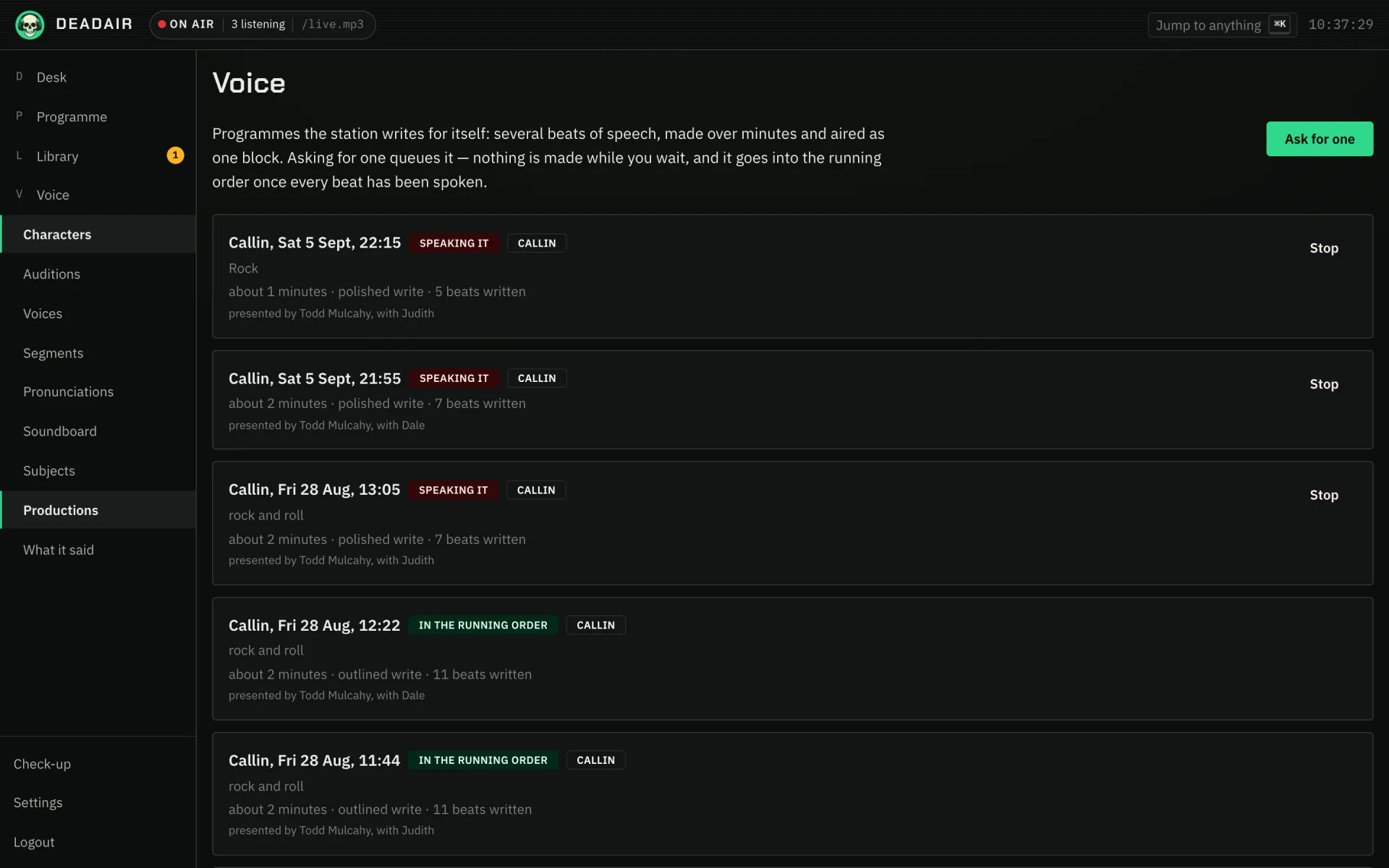 Fig. 1. Productions.
Callers
A caller is a character with a different job. It can never present, and it has no phrasings of its own: phrasings are the station's floor under a break, and a phone-in whose caller was written from a template has nobody on the phone. Five callers ship with the station, each with a voice no host uses, since the two are in one programme talking to each other. Add more with "New caller or guest…", then "New caller", on Voice, Characters. A caller keeps their own voice on the line: every caller is barred from the host's dialect, because a caller writes each turn with the host's turns in front of them and once came back talking like the host.
A caller can be tied to the hosts they ring in to, under "Rings in to" when you edit them, which is how one host's regulars stay on that host's show and off the breakfast show. A call casts only the callers tied to whoever is presenting it, plus any caller tied to nobody. Among those, it is a rotation: the caller heard from least recently goes first. Deleting a host unties its callers rather than silencing them. A station with no callers makes the programme with the host alone.
Guests in the studio
A visit is the same kind of short programme with a guest in the room instead of a caller on the line: your host welcomes them on ("joining me in the studio is…"), they talk, and the host thanks them for dropping by at the end. A guest is written as somebody sitting in the studio, answers at more length than a caller, and is held to the same rules about the weather as the host, since they are under the same sky. One guest per visit.
No guests ship with the station. Write them with "New caller or guest…", then "New guest", on Voice, Characters, and give each a voice no host uses. Like a caller, a guest never presents, has no phrasings, and can be tied to the hosts whose shows they visit. Ask for a visit with Bring in a guest on the Desk, or put a visit band on the format clock. A visit asked for on a station with no guests fails, and Productions says why, rather than airing your host alone.
Banter between co-hosts
On a show with co-hosts, a banter is the presenters trading lines for a few minutes: the host brings the others in by name, they react to each other, and the host hands back to the music. A show with co-hosts gets one every half hour without asking, the first as soon as it can be made; Minutes between banters under Settings, Breaks changes the spacing, and 0 turns them off. A show told not to talk gets none. Put a banter band on the format clock to have one at a set time as well; the band is passed over on a show with nobody beside the host. One asked for by hand on such a night fails, and Productions says why.
Three ways to take a call
- Take a call on the Desk puts somebody on the phone now, about what the broadcast is playing unless you type another subject. It lands a few minutes later, because the turns are written and spoken one at a time.
- A broadcast that takes calls. "Take calls" under Settings, Breaks (off by default), or "Take calls during this broadcast" on a single block. "Minutes between calls" (thirty by default) counts from when the last call aired. A setlist or a feature never takes calls.
- A clock band naming
callinon the format clock commissions one ahead of its slot.
All three inherit the show: its brief is the subject and its host presents. Otherwise a call would be about nothing in particular, presented by the station's default host rather than by whoever's programme it interrupts. Most shows have no brief, and then the call is about why the caller rang: one of the subjects their sheet says they keep coming back to. A subject you type, or a brief, still wins.
How a call is shaped
A call runs two to three minutes by default. The host speaks first and last, so the number of turns is always odd. Turns are short and uneven on purpose: the host asks and hands over in about twenty-three words, the caller answers in about forty-three, and a three-minute call comes to around fifteen turns. At seventy words a turn, as they once were, a call was two people reading paragraphs at each other.
A short call gets one caller. A second is cast only when there are turns enough for both, and never more than three, because past that a listener meets somebody new every thirty seconds and none of them is a character.
The host puts the caller on air and takes them off: the opening turn introduces somebody holding, the caller's first turn is the one place a greeting belongs, and the last turn closes the call. A caller whose sheet gives them room may be wrong. They say what they think, never about a real named person and never anything shaped like news, and the host's next turn takes it as their view rather than confirming it. With "polished" passes, the check reads each speaker's own sheet, including the words that speaker must never use, and names them when it sends a turn back to be rewritten.
Written, spoken, joined
"How much to write a production" sets the passes: quick (one draft per turn), outlined (plan, then write; the default), or polished (plan, write, then check and fix). Once every turn has been spoken, each is trimmed to where its speech starts and stops, and they are joined with "Pause between turns" between them: 200 milliseconds by default, anywhere from 0 to 2,000. The result airs as one item with one title on the stream.
Joining needs decoded audio, which never happens inside the station itself, so it goes to the plugin set under "Join audio with"; the bundled measurement sidecar does it. With none available, or if a join fails, the turns go in as a block, and the activity feed says which.
A change of presenter does not rewrite a programme's turns. A production needs a model, since there is no floor under a phone-in. One that cannot be written is marked failed on the Productions tab, with the reason.
A caller remembers
Every turn is recorded with its speaker, in the same history as the station's breaks, so callers take part in the nightly notebook and story passes exactly as hosts do. A caller is offered a story on their first turn only. Offered every turn, it becomes somebody telling the same anecdote three times in four minutes.
Other productions
The same machinery makes longer programmes in one voice. A clock band naming podcast, or "Ask for one" on the Productions tab, commissions one: a title, a brief in your own words, a length (eight to twelve minutes by default), how much to write it, and a presenter. The brief matters most, because the planning pass works from it. "Which productions have callers" decides which kinds are conversations; by default, only callin. Two other things fill an hour without being productions, and each has its own word: carrying somebody else's podcast, which fetches audio the station did not make, and reading somebody else's writing out, which is the station's own voice on words no model wrote.
Without anything to go on, a production talks from general knowledge and keeps the specifics vague, because a fact it is not sure of is left out. "Ask for one" can give it more. Notes, one per line, are the facts it may state, and given notes it states nothing as fact that they do not give. Sources are something for it to read first: the address of a web page, or pasted text. Given sources and no notes, the station reads them first, keeps only the claims it can find in their own words, and fails the production if it finds none rather than writing it from general knowledge. Research it on your trusted sites does the same with pages the web search plugin finds on the sites you trust. Air at holds a finished production, ready, for the first gap at or after that time; left empty, it airs as soon as it is made. A show of your own on the Podcasts tab keeps these choices for you, so each episode is one button.
In the console
On the Desk, Take a call asks for a phone-in now and Bring in a guest asks for a visit, each with an optional subject. Voice, Productions lists what the station is making and has made: its state (queued, planning it, writing it, checking it, speaking it, joining it up, ready, in the running order), its length, how many turns are written, who is on it, and a Stop button while one can still be stopped. The words are on Voice, What it said. Call spacing is under Settings, Breaks; length, passes and pause under Settings, Voice and audio; which plugin joins the turns up under Settings, Providers.